
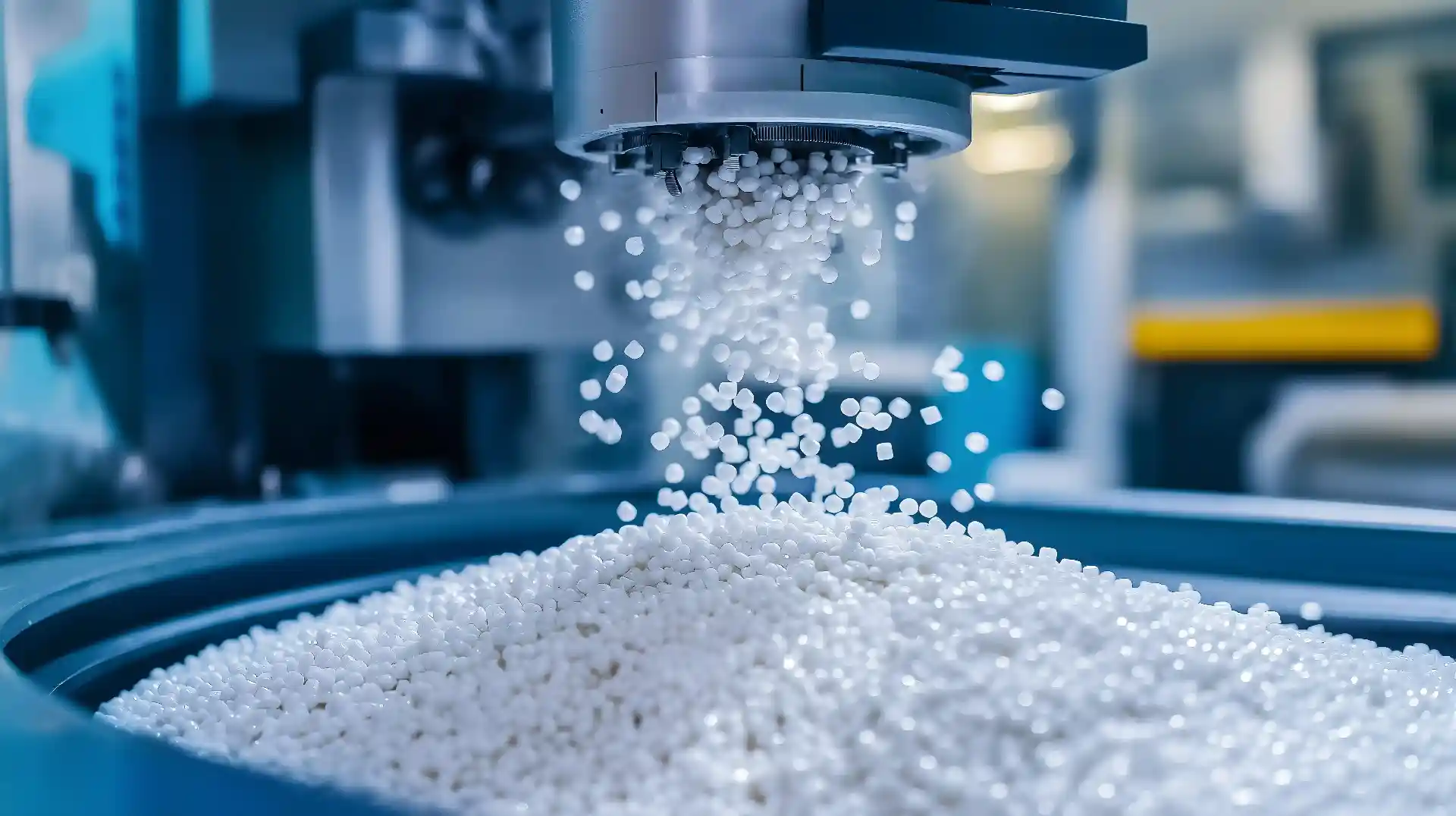
White masterbatch is a concentrated pigment system used to introduce white color and visual performance into polymer products. It carries selected white pigments, usually titanium dioxide, in a compatible carrier resin so the final product gains consistent brightness, opacity, and stability during processing.
For polypropylene (PP) and polyethylene (PE) applications, a well-formulated white masterbatch can improve whiteness, hiding power, and repeatability from batch to batch. This is especially important in products such as raffia, tapes, woven sacks, film, packaging, and molded parts where appearance and processing consistency are critical.
WHITE MASTERBATCH | PRODUCT GUIDE
White Masterbatch: Brightness, Opacity and Processing Performance for Polypropylene and PE Products

White masterbatch is a concentrated formulation in which a white pigment system is dispersed into a polymer carrier. Instead of dosing raw pigment directly, the producer feeds a pre-dispersed pellet that is easier to meter, blend, and handle.
This approach offers several practical advantages:
- Higher brightness and cleaner whiteness
- Better hiding power and opacity
- More uniform color in the final product
- Easier dosing and better process control
- Lower dust during handling and storage
- Improved batch-to-batch consistency
Titanium dioxide is the most common white pigment used in polymer masterbatches because it gives excellent opacity and high whiteness. In a properly designed formulation, TiO2 particles are well dispersed to reflect and scatter light effectively, helping the product keep a strong white appearance.
The overall performance depends on the right balance between pigment loading, carrier resin, dispersion quality, and processing conditions. A suitable white masterbatch should not only improve color but also maintain mechanical and processing stability.
White masterbatch is widely used in:
- Raffia and woven sack production
- Tapes and film applications
- Injection and blow molded products
- Packaging and consumer plastic goods
- Agricultural products and industrial applications
In many of these applications, product appearance is part of the value proposition. A bright, uniform white finish can improve product acceptance in both industrial and consumer markets.
When choosing a white masterbatch, it is important to consider:
- Base polymer compatibility such as PP or PE
- Required opacity and brightness level
- Processing temperature and shear conditions
- Compatibility with other additives or pigments
- Evaluation under real production conditions
A masterbatch should be selected not only for the final appearance but also for how it behaves during extrusion, molding, and downstream converting.
Conclusion
A high-quality white masterbatch helps manufacturers produce brighter, cleaner, and more consistent polymer products while maintaining stable processing performance. POLYCHEM develops white masterbatch solutions built for dependable results in modern polymer applications.